

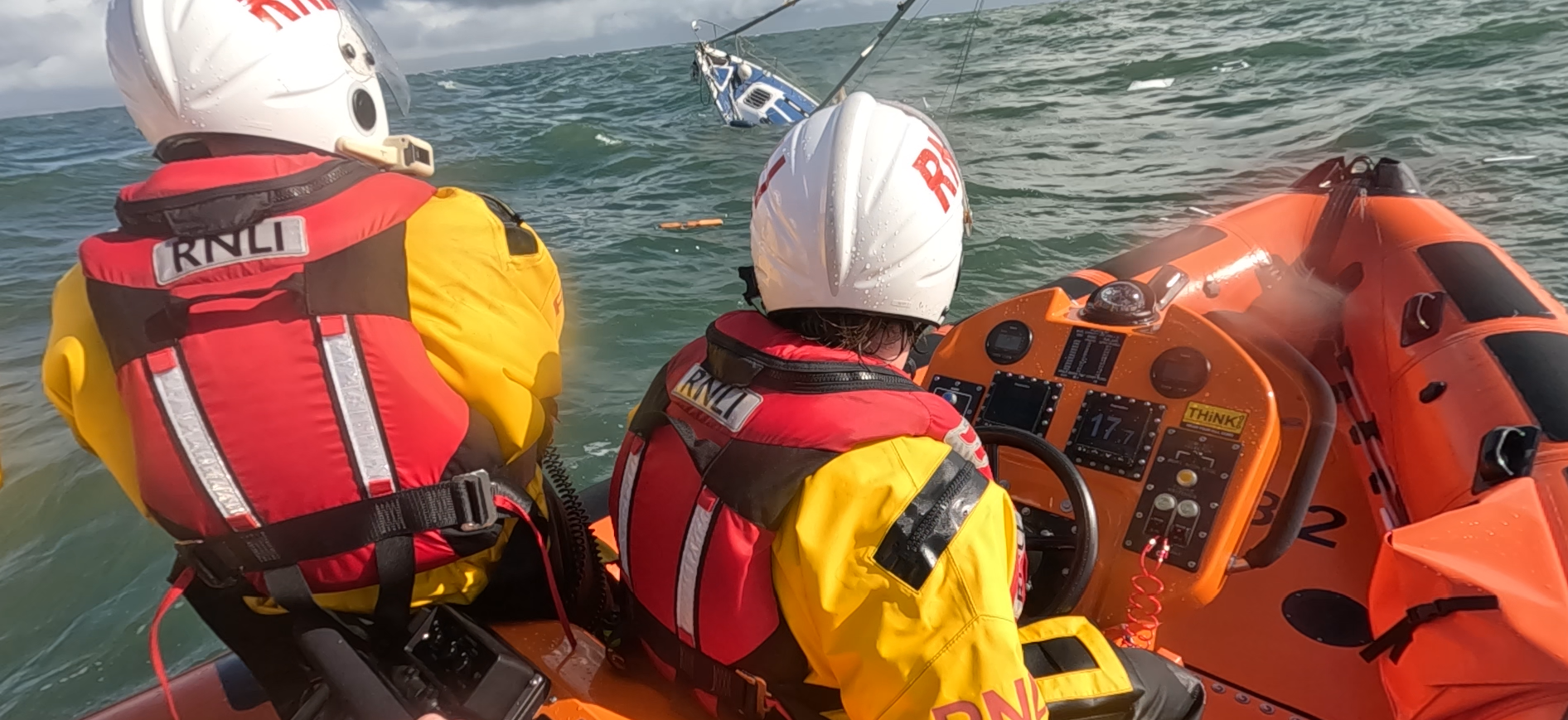
Following a 999 call, volunteer lifeboat crews from Porthcawl and The Mumbles RNLI rescued a lone sailor after their yacht ran aground on a sandbank and became flooded, leaving it at risk of sinking.
On the afternoon of Friday 28 August 2026, Porthcawl’s Atlantic 85 lifeboat Rose of the Shires launched at 3.10pm into strong force 5-6 south-westerly winds and moderate sea conditions, making best speed towards Scarweather Sands, a large linear sandbank located in the Bristol Channel.
The lifeboat passaged out in challenging conditions and as the volunteer crew got closer to Scarweather sandbank, they were initially unable to spot the casualty vessel. Due to the conditions, the crew were also struggling to locate them using radar. With the sailor unable to use their VHF radio onboard the yacht, they were requested to fire a red flare, after which the lifeboat crew spotted the vessel.
Once on scene, the Atlantic 85 lifeboat crew did an initial assessment and observed that the yacht had taken on a significant amount of water. A decision was made to put a lifeboat crew member onboard the yacht to further assess the situation. It was immediately apparent that the crew needed to get the sailor off as quickly as possible, as it would be impossible to stem the flow of water. The sailor was safely transferred on to the inshore lifeboat before the vessel sank.
Meanwhile The Mumbles all-weather lifeboat Roy Barker IV was making its way to the scene. Once The Mumbles crew had arrived and due to the challenging sea conditions, the sailor was transferred to the all-weather lifeboat and taken safely ashore at Swansea.
Speaking at the time following the call out, Porthcawl RNLI Lifeboat Operations Manager, Andrew Walmsley, said:
‘The crew did a great job in difficult conditions. Time was of the essence and to locate the sailor quickly with limited information and evacuate them from the sinking yacht resulted in a life saved.
‘The Bristol Channel has the second largest tidal range in the world and can present people with challenging conditions where it can be easy to get caught out. We would like to commend the casualty for being prepared and having multiple means to call for help as well as appropriate safety equipment.
‘Should you get into difficulty or see someone else in trouble on the coast, call 999 or 112 and ask for the Coastguard.’
The RNLI’s safety checklist for sailing and boating is:
- Always wear an appropriate lifejacket
- Always carry a means of calling and signalling for help
- Ensure there is an emergency action plan in place and everybody has an onboard briefing (in particular on the location and use of the safety equipment, including the spare kill cord for powerboats)
- Get the right level of training for your craft
- Always check the weather and tide times
- Make sure someone ashore knows where you are going and who to call if you don’t return on time
- Always drive your boat at a speed that is appropriate to the weather conditions and to the environment you are operating in.

Get Social